Why dental lab remakes happen (and how to cut them)
Why dental lab remakes happen is the question every lab owner ends up asking after eating the cost of a crown that didn't seat, a shade that didn't match, or a bridge that came back a second time. A remake is never just wasted material and technician hours — it's also the harder-to-quantify cost of a clinic starting to wonder whether your lab is reliable. The good news: remakes usually aren't random. A small set of causes — a compressed shade photo, a prescription missing one detail, no record of what was actually agreed — accounts for most of them, and all three are fixable without touching who does the actual production work.
Last updated July 14, 2026
Why dental lab remakes happen, and what's behind it?
Ask a lab manager why a case got remade and you'll usually get an answer about the technician, the material batch, or a clinic that's "just picky." Rarely does anyone look at the shade photo, the prescription, or the record of what was actually sent — but that's where most preventable remakes actually start.
- A shade photo compressed by a messaging app until the colour reference is no longer trustworthy.
- A prescription that arrived with a detail missing — margin design, shade system, or occlusion notes left blank because nothing forced them to be filled in.
- No shared record of what was actually sent and agreed, so a dispute over the cause eats up more time than remaking the piece would.
None of these three is a skill problem. They're a system problem — and systems can be fixed.
Why is the shade photo usually the culprit?
A shade photo is the single most information-dense file in a case, and it's also the file most likely to travel through a chat app before it reaches the lab. Every re-share and every re-upload strips a little more detail and shifts the colour balance a little further — by the time it lands on a technician's screen, it may no longer show the shade the dentist actually saw chairside.
That's the specific failure LabCaseBook closes: every shade, impression, scan, and x-ray upload is stored exactly as the clinic captured it — byte-for-byte, with an integrity checksum — and carries a Full resolution badge on the lab's side. There's no re-encoding step to introduce drift, because there's no re-encoding at all.
How do you know whose fault a remake really is?
When a clinic reports a remake, the conversation almost always turns into "whose fault is it" before it turns into fixing the piece — and without a record, that argument runs on memory, which is exactly as reliable as everyone's incentive to be right.
A structured case removes the ambiguity. Every remake request is recorded with a cause the clinic actually selected, a written note, and an attempt number (Attempt 2, then 3…), sitting alongside the photos of the problem — appended to the case's History, which nobody can edit or delete after the fact.
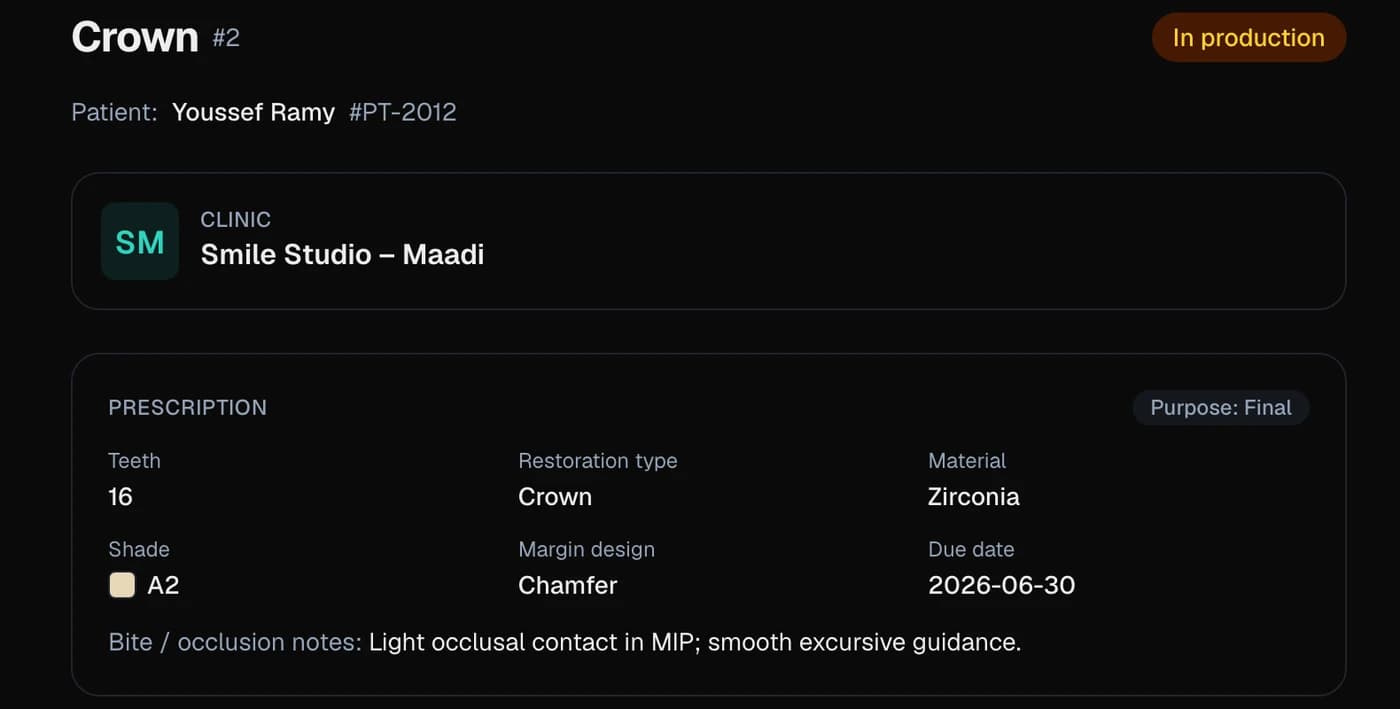
Whether the cause traces back to the clinic side (an impression that wasn't sharp enough) or the lab side, the record shows it plainly. That's not a feature that assigns blame automatically — it's a feature that gives both sides the same facts, so the argument that used to take longer than the remake itself just doesn't happen anymore.
How do you cut remakes without replacing your team?
The instinct after a bad month of remakes is to tighten supervision on the production floor. The more effective fix usually happens before the case ever reaches a technician's bench.
- Block incomplete prescriptions at the source — a form that requires margin design, shade system, and occlusion notes before it can even be sent stops the guessing that turns into a remake later.
- Store shade and impression photos exactly as captured — a Full resolution badge on every photo means the technician is matching against what the dentist actually saw, not a compressed copy of it.
- Record every remake's cause and let it accumulate — a visible Remake rate on your scorecard turns "we think it's gotten better" into a number you can actually track.
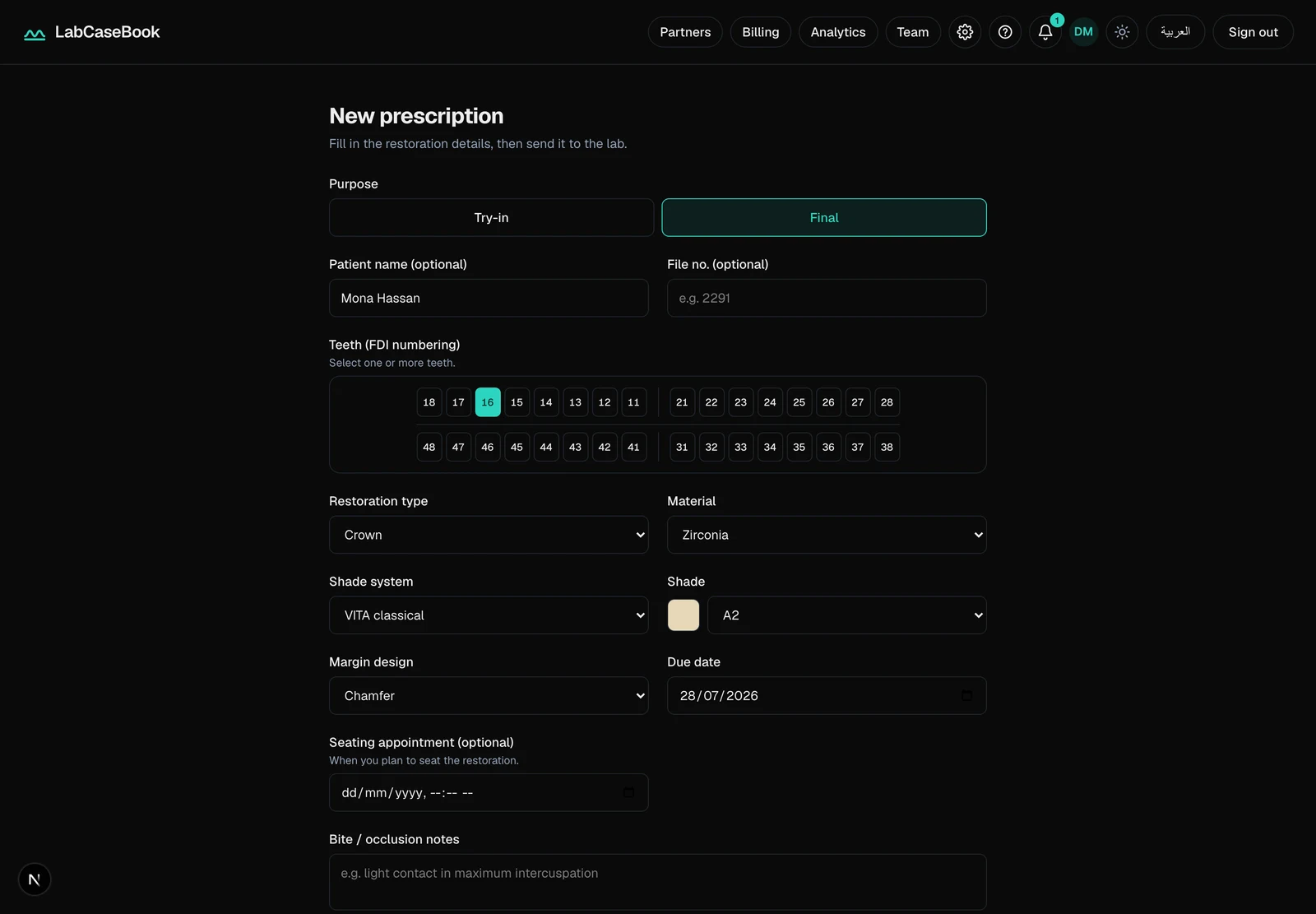
None of that requires firing anyone. It just requires making sure the technician never has to guess.
Common questions
- Is a remake automatically the technician's fault?
- Not usually. Most preventable remakes trace back to what arrived before production even started — a compressed shade photo or an incomplete prescription — not to a technician's workmanship. Fixing the intake reduces remakes more reliably than tightening supervision on the bench.
- Can I actually stop shade photos from getting compressed?
- Yes, if they stop travelling through a messaging app before they reach you. LabCaseBook stores every shade photo byte-for-byte, with a Full resolution badge, so what the technician sees is what the dentist shot — no recompression step in between.
- How do I prove a remake wasn't my lab's fault?
- Every remake request is recorded with the reason the clinic chose, its note, and the attempt number, appended to the case's permanent History. That record — not anyone's memory of the conversation — is what settles the dispute.
- Do incomplete prescriptions really cause that many remakes?
- A prescription missing a margin design, shade system, or occlusion note forces the technician to guess at exactly the details a remake later gets blamed on. A structured Rx form that can't be submitted incomplete removes that guesswork before the case ever reaches production.
- Does recording a remake's cause automatically decide who pays for it?
- No — LabCaseBook doesn't decide who pays. What the recorded cause, note, and photos do is give both sides the same facts, so that conversation is quick instead of an argument from memory.
Related pages
New to LabCaseBook? Start from the homepage or browse the Help Center.